Most inquiries about custom Kalrez seals and O-rings reach Hitron after a catalog part has already failed twice. The buyer has a dash number, a groove drawing, and a tool that is down. The real question is not which compound is best in the abstract. It is whether this seal can stay on the AS-568 shelf or has to go to a mold. That line is narrower than most purchasing teams assume, and it is worth drawing before the next failure.
Kalrez is the perfluoroelastomer brand of DuPont de Nemours, and the name appears here because that is what sits on most existing drawings and BOM lines. Hitron is not a licensee of that brand. The seals shipped from Wuxi are compatible parts built to the same callouts, quoted against perfluoroelastomer grades of comparable performance, and priced on a domestic supply route.
Read the Dash Number Before You Draw Anything
The dash number is the first thing worth reading on any seal request. It fixes the bore and the cross-section, and it tells a supplier within minutes whether the request is a shelf pick or a tooling project.
What a K# Callout Already Fixes
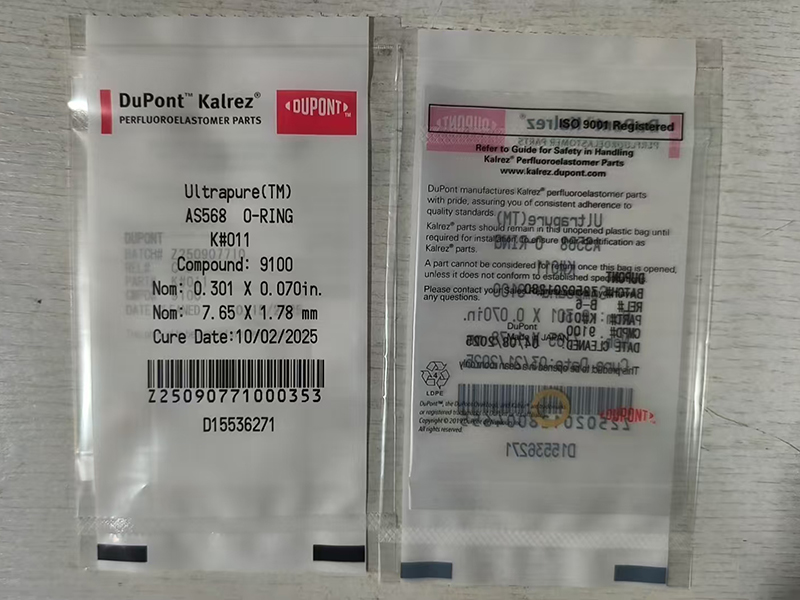
An AS-568 dash number, often written as K# on drawings that came out of Japanese and Chinese fabs, is a fixed bore and cord combination. Hitron holds grade 9100 in K# 011 at 7.65 × 1.78 mm, K# 105 at 3.63 × 2.62 mm, K# 123 at 29.82 × 2.62 mm, and K# 222 at 37.69 × 3.53 mm. Grade 6375UP is held in K# 026 at 31.47 × 1.78 mm. If the groove was cut for one of those, no engineering work is left. Order the part, check the cure date, install it.
|
Part number |
K# |
Grade |
Size (mm) |
Size (in) |
|
D15536271 |
011 |
9100 |
7.65 × 1.78 |
0.301 × 0.070 |
|
D13384839 |
105 |
9100 |
3.63 × 2.62 |
0.143 × 0.103 |
|
D15331553 |
123 |
9100 |
29.82 × 2.62 |
1.174 × 0.103 |
|
D15554678 |
222 |
9100 |
37.69 × 3.53 |
1.484 × 0.139 |
|
D13361964 |
026 |
6375UP |
31.47 × 1.78 |
1.239 × 0.070 |
A dash number describes a torus, not a groove. If the cavity has lost its squeeze, a catalog part with the right number still leaks, and no grade upgrade will rescue it.
Where the Standard Range Stops
Coverage ends in three places. Very large bores fall outside the stocked dash range. Cross-sections below roughly 1.5 mm become difficult to mold and harder still to measure on the bench. Any non-circular geometry, from rectangular frames to dovetail profiles to seals with locating tabs, has no dash number at all. Those three cases are where custom Kalrez seals and O-rings actually begin.
The Mold Is Rarely the Expensive Part
Tooling cost is visible and easy to argue about. The cost that hurts is the stretch between a purchase order and a qualified part, while the chamber stays open.
Non-Standard Cross-Sections and the Compression Set Budget
Compression set is the number that predicts whether a seal still seals after a thermal cycle. The perfluoroelastomer family carries a set figure under 15 percent by the ASTM method, and hardness across the range runs 60 to 90 Shore A. Push the durometer upward to survive a rough groove and the seal loses its ability to conform at the cold end of the range. A soft seal that extrudes has failed, and so has a hard seal that cannot follow a rough surface.
Split, Bonded, and Machined Workarounds
Not every non-standard request needs a new mold. A spliced ring cut from cured cord covers a bore that no dash number reaches. A bonded assembly lets a seal sit on a metal or ceramic carrier without field adhesive work. A machined perfluoroelastomer part suits low volume and awkward geometry, where mold amortization never pays back. Each route trades a different risk: spliced rings put a joint in the seal path, bonded parts add an interface, machined parts cost more per piece.
Lead Time You Cannot Compress
Sampling, first-article measurement, and customer approval run in sequence, and none of them speed up because the order is marked urgent. Open the tooling conversation while the current part is still working. A seal that arrives while the tool is still running is worth more than a discount that arrives with the failure.
Pick the Grade From the Media List, Not the Data Sheet Headline
Most custom Kalrez seals and O-rings are quoted against a grade name the buyer already has on a drawing. Every perfluoroelastomer data sheet opens with the same claim: resistance to more than 1800 chemical media, from strong acids and bases to amines, solvents, and steam. The claim is true of the family, and it says nothing about the bag in front of you.
A Compound Number Is Not a Specification
Grade 9100, 6375UP, and ZALAK 5100 are formulation codes, and each one carries its own hardness and its own compression set behavior. Ask for the data sheet of the exact grade, not the family sheet. If a supplier cannot name the grade on the quotation, the quotation covers a family, and a family cannot be installed in a chamber.
Three Grades in the Hitron Stock List
Grade 9100 appears across K# 011, 105, 123, and 222 in the current list, which makes it the working default for standard grooves. Grade 6375UP is carried in K# 026. ZALAK 5100 is listed under code KB82209 as part number 110720000 and should be ordered by that code rather than a remembered trade name. Availability is not a specification: a grade in stock says nothing about whether it survives your process gas. Confirm the grade against the media list, then confirm the size.
The Temperature Envelope and What the Top of It Costs
|
Property |
Figure |
Where it comes from |
|
Temperature window |
-20 °C to +316 °C |
product page rating |
|
Continuous service |
325 °C (617 °F) |
descriptive copy |
|
Peak temperature |
327 °C |
descriptive copy |
|
Hardness |
60–90 Shore A |
family range |
|
Compression set |
under 15% |
ASTM method |
|
Chemical resistance |
1800+ media |
family claim |
Read those as three different claims. The page figure is the safe operating window, the continuous figure is a service statement, and the peak figure is a transient. Writing the peak number into a continuous requirement is a common and expensive mistake, because the grades that survive it give up low-temperature flexibility and recovery. Headroom at the top is paid for at the bottom.
Tolerance and Flash: Where Custom Parts Are Won or Lost
A custom seal that measures right on the bench and leaks in the chamber usually lost the argument at the drawing stage, not in the mold. More custom Kalrez seals and O-rings fail on tolerance and flash clauses than on compound choice.
What Belongs on the Drawing
1. Inside diameter and cross-section, each with its own tolerance band, referenced to the groove dimensions rather than to a nominal dash number.
2. Flash limit and permitted parting-line location, stated as a maximum projection in millimeters on the sealing face only.
3. Grade designation, hardness in Shore A, and the cure date and traceability code that must appear on the bag.
4. The inspection method agreed up front, including whether cross-section is measured optically or by contact.
Tighter Flash Limits Are Not Free
Flash is the material that escapes at the parting line. On a face seal, flash across the sealing surface is a leak path. On the outside diameter it is usually cosmetic. Buyers often ask for one blanket tight limit because a tight number feels like quality control. It is not. A tight limit on a large frame drives mold maintenance, slows the press, and raises the price of every part in the run, while a limit applied only to the sealing face costs almost nothing.
Measuring a 1.78 mm Cross-Section Without Squeezing It
A 1.78 mm cord is soft enough that a careless micrometer reading will be wrong by more than the tolerance it is meant to verify. Optical comparison against a shadow graph, or a micrometer with a controlled anvil force, gives a number worth writing down. Two operators with a cheap caliper will disagree, and that disagreement becomes a non-conformance report.
Cure Date and Trace Code: The Two Lines That Settle Claims
Shelf Life Starts at the Cure Date
Elastomer shelf life is counted from cure, not from shipment. A ring that sat in a stockroom bin for two years before it reached your store is already partway through its useful life, whatever the packaging says. The cure date on the label is the only field that tells you this, and it is the first field to check at goods-in for
custom Kalrez seals and O-rings as much as for shelf parts.
Recording the Trace Code at Goods-In
Each Hitron seal carries a product traceability code next to the cure date. Z25090771000353, T24120577200229, and Z25021208001634 are examples from the current list. Record the code against the part number and the lot that goes into the chamber. When a seal fails early, that string is what lets a supplier trace the cure batch, the compound lot, and the molding run behind one specific piece. Without it, a failure review turns into a memory test between two companies.
|
Field |
Example entry |
What it protects |
|
Part number |
D15536271 |
ties the piece to a drawing revision |
|
Grade |
9100 |
fixes the formulation actually molded |
|
Size |
K# 011, 7.65 × 1.78 mm |
confirms the dash number shipped |
|
Cure date |
copied from the label |
starts the shelf-life clock |
|
Trace code |
Z25090771000353 |
traces cure batch and molding run |
Bonded Door Seals: 9100 on a Slit Valve Door
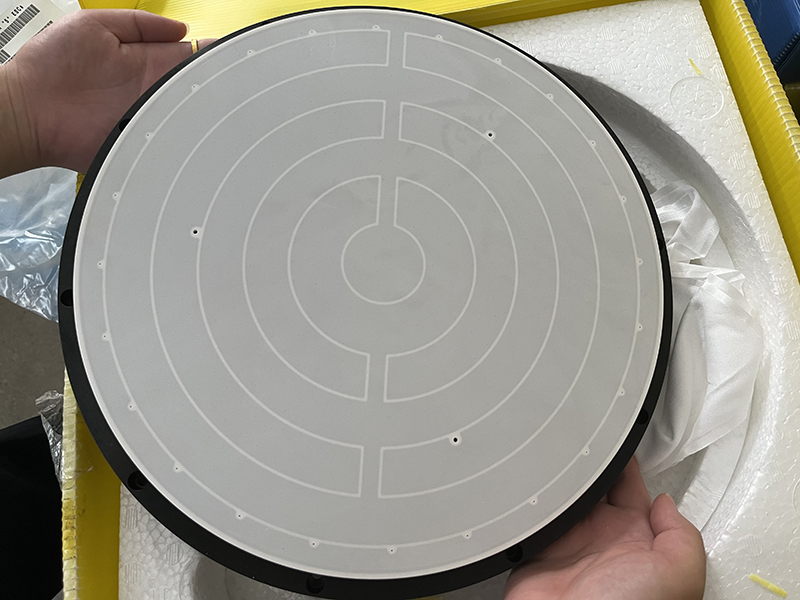
A bonded door seal is a different product from a ring, even when the compound is identical. The seal is cured onto the door, the door is a moving part, and the failure mode is usually debonding rather than compression set.
Why Bond Rather Than Clamp
Clamping a ring into a groove works when the groove is machined into a rigid body and the ring is replaced on schedule. A slit valve door is thin, it flexes, and it gets handled during cleaning. Bonding grade 9100 onto the door removes the groove, keeps the seal from rolling or lifting through pump and vent cycles, and turns the assembly into one part to stock. The trade is that the seal can no longer be changed on its own.
Surface Preparation Decides the Bond
Most debonding traces back to the substrate, not the adhesive. Aluminum and stainless doors need a defined cleaning and priming sequence, and a primed surface has a finite window before bonding. Bond line thickness needs a target, not a range as wide as the drawing. A 9100 door seal on a prepared door behaves as one part; the same seal on an oily surface peels at the first vent cycle.
Leak Check, Storage, and How to Order
After bonding, leak check the assembly rather than the ring alone, then store it flat in a clean bag with the cure date visible.
Custom Kalrez seals & O-rings of this type are quoted from four inputs together: the drawing, the grade, the substrate, and the door revision. A door revision that moves the seal groove changes the tool, and a quote against the old revision is worth nothing. Send those four items and the quote comes back without clarifying questions. Wuxi Hitron Semiconductor Co., Ltd. moulds and bonds these seals in-house and answers on +86 18101522032 or Jerry@hitronsemi.com.