What Is FFKM?
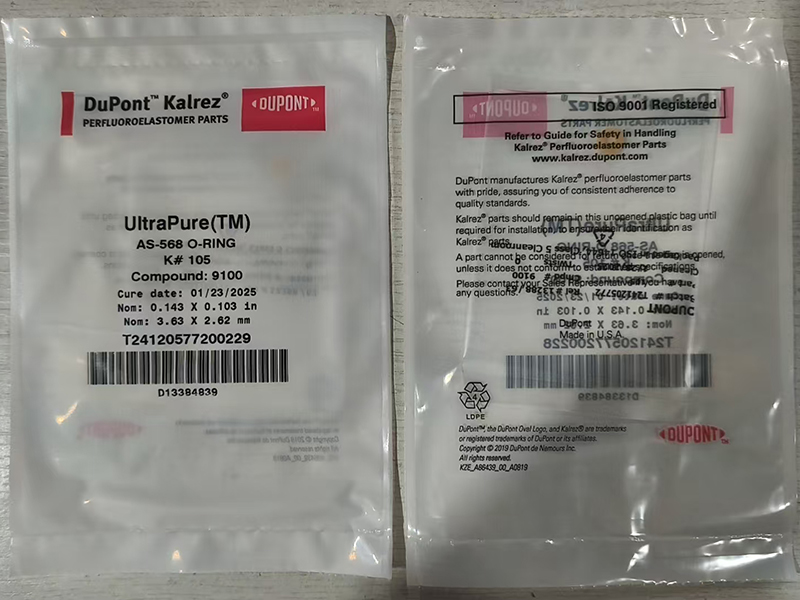
FFKM (perfluoroelastomer) is a fully-fluorinated elastomer that combines the elasticity of a rubber with the chemical resistance and thermal stability of PTFE, providing sealing performance in aggressive chemical and high-temperature environments where standard elastomers (FKM, EPDM, silicone) would degrade. FFKM is sold under trade names including Kalrez (DuPont / Chemours), Chemraz (Greene Tweed), Kalrez Spectrum, and Perlast (PPE).
Typical FFKM applications:
Semiconductor etch chamber seals (O-rings, gaskets, custom shapes).
CVD / PECVD chamber seals.
PVD chamber seals.
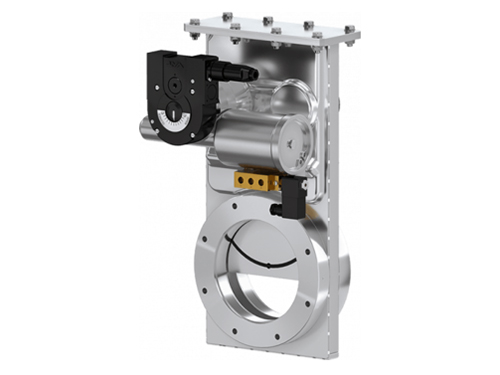
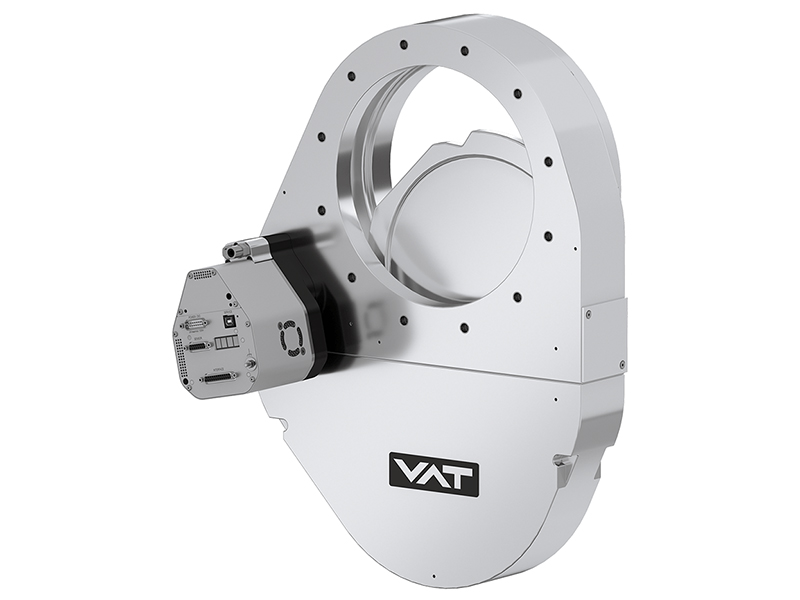
Slit valve door seals (see Article 02).
Load lock and transfer chamber seals.
Wet-process equipment seals (acid, base, solvent).
Analytical and life-science instrument seals.
FFKM is the standard sealing material for production semiconductor tools because it provides the broadest chemical compatibility and the longest MTBF among elastomers.
How Is FFKM Different from FKM and EPDM?
FFKM is fully fluorinated, providing the highest chemical and thermal resistance; FKM is partially fluorinated and provides lower cost and lower temperature; EPDM is non-fluorinated and provides the lowest cost and lowest chemical resistance. The choice depends on the chemistry, temperature, and cost target.
|
Property |
FFKM |
FKM (Viton) |
EPDM |
Silicone |
|
Fluorination |
Full |
Partial |
None |
None |
|
Max temperature (continuous) |
+200 to +325 °C |
+150 to +200 °C |
+150 °C |
+200 °C |
|
Min temperature |
−10 °C (typ.) |
−26 °C |
−50 °C |
−60 °C |
|
Chemical resistance |
Excellent (broadest) |
Good (limited) |
Limited |
Limited |
|
Plasma resistance |
Compound-dependent |
Poor |
Poor |
Poor |
|
Compression set |
Good (compound-dep.) |
Good |
Fair |
Fair |
|
Cost |
Very high |
Medium |
Low |
Low |
|
Outgassing |
Low |
Medium |
Medium |
Medium |
|
Vacuum service |
Yes |
Limited |
Limited |
Limited |
For semiconductor plasma service, FFKM is the standard because of its combination of chemical resistance, temperature, and plasma tolerance.
What Are the Standard FFKM Compounds?
Standard FFKM compounds are differentiated by their cure system, filler, and performance profile, with the most common semiconductor compounds being Kalrez 4079, 6375, 9100, 9500, 1050LF, and similar Chemraz / Perlast equivalents. Each compound is optimized for a specific service profile.
|
Compound |
Cure system |
Max temp |
Notes |
|
Kalrez 4079 |
Peroxide |
+200 °C |
General semiconductor, low particle |
|
Kalrez 6375 |
Peroxide |
+200 °C |
Broad chemical, etch service |
|
Kalrez 9100 |
Peroxide |
+200 °C |
Low compression set, vacuum |
|
Kalrez 9500 |
Peroxide |
+325 °C |
High-temperature, ALD / PVD |
|
Kalrez 1050LF |
Peroxide |
+200 °C |
Low friction, dynamic seal |
|
Chemraz 505 |
Peroxide |
+200 °C |
General semiconductor |
|
Chemraz 555 |
Peroxide |
+325 °C |
High-temperature |
|
Perlast G67P |
Peroxide |
+200 °C |
General semiconductor |
For etch chamber service (typ. +100 to +200 °C, plasma + chemistry), 4079 and 6375 are the standard. For high-temperature (PVD, ALD, > +250 °C), 9500 and 555 are required.
How Does FFKM Behave in Plasma?
FFKM behavior in plasma depends on the compound, the plasma chemistry (O₂, CF₄, SF₆, Cl₂, HBr), and the plasma conditions (power, pressure, duty cycle), with most FFKM compounds losing 5–50 nm/min of surface under aggressive plasma and forming a passivation layer that protects the bulk elastomer. The plasma erosion rate determines the seal lifetime.
|
Plasma chemistry |
Erosion rate (typical FFKM) |
Notes |
|
O₂ plasma |
20–100 nm/min |
Moderate, forms oxide layer |
|
CF₄ / CHF₃ plasma |
10–50 nm/min |
Lower, fluorinates surface |
|
SF₆ plasma |
30–80 nm/min |
Moderate, sulfur reacts |
|
Cl₂ / HBr plasma |
20–60 nm/min |
Moderate, halogens react |
|
Ar plasma (sputter) |
50–200 nm/min |
High, physical erosion |
For etch chamber service, FFKM seals are typically replaced every 6–18 months depending on plasma chemistry and process uptime. Particle generation is the leading indicator of replacement timing.
What Are the Mechanical Properties of FFKM?
FFKM has typical elastomeric mechanical properties (hardness 70–90 Shore A, tensile strength 10–20 MPa, elongation 100–250 %, compression set 15–30 %) with the advantage of fluorine-based backbone providing the chemical and thermal resistance. The mechanical properties determine the seal's compression set, recovery, and dynamic sealing capability.
|
Property |
Typical FFKM range |
Notes |
|
Hardness |
70–90 Shore A |
Compound-dependent |
|
Tensile strength |
10–20 MPa |
Compound-dependent |
|
Elongation at break |
100–250 % |
Compound-dependent |
|
Compression set (70 h, +200 °C) |
15–30 % |
Determines sealing recovery |
|
Specific gravity |
1.9–2.1 g/cm³ |
Higher than FKM (1.8) |
|
Glass transition |
−10 to −30 °C |
Compound-dependent |
For static seals, compression set of 15–25 % is acceptable. For dynamic seals (rotating, reciprocating), compression set < 20 % is preferred to maintain sealing force.
What Are the Standard Seal Geometries?
FFKM seals are available in standard geometries (O-ring, square ring, custom gaskets) and standard sizes (AS568, metric, JIS, custom). For semiconductor tools, custom geometries are common because the seal must match the chamber's specific groove dimensions.
|
Geometry |
Standard |
Application |
|
O-ring (circular) |
AS568, metric, JIS |
Static seal, general |
|
Square ring |
Custom |
Static seal, easy extrusion |
|
Custom gasket |
Drawing-specific |
Static seal, complex shape |
|
Lip seal |
Custom |
Dynamic seal, low friction |
|
U-cup |
Custom |
Dynamic seal, reciprocating |
For slit valve doors and chamber flanges, O-rings and square rings are standard. For static-to-static interfaces (chamber lid, viewport), custom gaskets are common.
What Is the Vacuum Performance?
FFKM has excellent vacuum performance with outgassing rates of < 1×10⁻⁹ std cc/s He at room temperature and < 1×10⁻⁸ std cc/s He at +200 °C, with weight loss < 1 % after 24 h at +200 °C in vacuum. FFKM is qualified for UHV service per SEMI standards.
|
Property |
Typical FFKM |
Notes |
|
Outgassing (TML) |
< 1 % |
NASA E1061 |
|
CVCM |
< 0.1 % |
NASA E1061 |
|
Vacuum weight loss |
< 1 % / 24 h @ +200 °C |
SEMI |
|
Helium leak rate |
< 1×10⁻⁹ std cc/s |
Compression-loaded |
|
Permeability |
Low |
Hydrogen, helium |
For UHV semiconductor tools, FFKM seals are specified per SEMI E12 and tested per ASTM E595 (TML / CVCM) for space-qualified service.
How Is FFKM Cleaned and Handled?
FFKM seals must be cleaned and handled in ISO Class 3 or better cleanroom environment to prevent particle contamination, with standard cleaning protocols using ultrapure water, IPA, and CO₂ snow or UV-ozone for surface organic removal. Cleanroom packaging is standard for semiconductor-grade FFKM seals.
|
Cleaning step |
Method |
Notes |
|
Pre-clean |
Ultrapure water + IPA |
Removes particles |
|
Surface organics |
UV-ozone or CO₂ snow |
Removes hydrocarbons |
|
Drying |
Vacuum or N₂ purge |
Prevents watermark |
|
Packaging |
Double-bag, cleanroom |
Maintains cleanliness |
|
Storage |
< +25 °C, < 50 % RH |
Prevents aging |
For ISO Class 3 cleanroom tools, FFKM seals are typically supplied pre-cleaned and double-bagged. Re-cleaning in the field is not recommended.
How Is FFKM Selected for an Application?
FFKM selection requires matching compound (cure, filler, profile), temperature, chemistry, plasma, and mechanical requirements to the application's priority. The selection process:
Identify the chemistry (acid, base, solvent, plasma).
Identify the temperature range (continuous + excursion).
Identify the mechanical requirement (static vs. dynamic, compression set).
Identify the regulatory requirement (FDA, USP, SEMI).
Select the compound from the standard catalog.
Verify with prototype test under actual conditions.
Hitron's Kalrez O-Ring family covers the standard FFKM compounds for semiconductor service. For non-standard requirements, custom compounds are available.
How Does FFKM Compare to Metal Seals?
FFKM provides the best elastomeric performance but is limited to +200 to +325 °C depending on compound; metal seals (Cu, Al, Au) provide higher temperature (up to +450 °C) and lower leak rate (< 1×10⁻¹⁰ std cc/s He) but lower cycle life and higher cost per cycle. The choice depends on the application's temperature and uptime.
|
Property |
FFKM |
Metal (Cu) |
Metal (Au) |
|
Max temperature |
+325 °C |
+450 °C |
+450 °C |
|
Min temperature |
−10 °C |
Cryogenic |
Cryogenic |
|
Leak rate |
< 1×10⁻⁹ std cc/s He |
< 1×10⁻¹⁰ std cc/s He |
< 1×10⁻¹¹ std cc/s He |
|
Cycle life |
1,000,000+ |
100,000 |
10,000 |
|
Cost per cycle |
Low |
High |
Very high |
|
Reusability |
No |
Limited |
No |
For chamber isolation (typ. +100 to +200 °C, frequent cycling), FFKM is the standard. For high-temperature process modules (typ. > +250 °C), metal seals are used.
Frequently Asked Questions
Q: What is FFKM?
A: FFKM (perfluoroelastomer) is a fully-fluorinated elastomer that combines the elasticity of rubber with the chemical resistance and thermal stability of PTFE. The most common trade name is Kalrez (DuPont / Chemours).
Q: What is the difference between FFKM and Kalrez?
A: FFKM is the generic material name; Kalrez is a specific trade name. Other FFKM trade names include Chemraz, Perlast, and Kalrez Spectrum. All are FFKM but with different compound formulations.
Q: What is the maximum temperature for FFKM?
A: Standard FFKM compounds are rated +200 °C continuous; high-temperature compounds (Kalrez 9500, Chemraz 555) are rated +325 °C continuous. For higher temperatures, metal seals are required.
Q: Can FFKM be used in plasma?
A: Yes. FFKM is the standard elastomer for semiconductor plasma service, with typical erosion rates of 5–50 nm/min depending on the compound and plasma chemistry.
Q: How is FFKM cleaned?
A: FFKM is cleaned with ultrapure water, IPA, and (for surface organics) UV-ozone or CO₂ snow, in ISO Class 3 or better cleanroom environment. Cleanroom packaging is standard for semiconductor-grade FFKM.
Q: Can FFKM seals be reused?
A: FFKM seals are typically single-use, replaced at preventive maintenance. Compression set recovery is limited, so re-used seals may not provide reliable sealing.
Q: What is the typical FFKM lifetime in etch service?
A: 6–18 months depending on plasma chemistry, temperature, and uptime. Particle generation and dimensional loss are the leading indicators.
Q: Does Hitron offer custom FFKM compounds?
A: Yes. Hitron's Kalrez O-Ring family includes standard and custom FFKM compounds for OEM and aftermarket applications. Contact the Hitron engineering team for custom requirements.
Q: Is FFKM FDA / USP compliant?
A: Yes, certain FFKM compounds (e.g., Kalrez 6221, 6230) are FDA-compliant for food contact and USP Class VI for pharmaceutical and life-science service. Standard semiconductor-grade compounds are not FDA-compliant.
Conclusion
FFKM (Kalrez) is the highest-performance elastomer family for semiconductor plasma service, providing the broadest chemical resistance, the highest temperature range among elastomers, and the longest MTBF. Compound selection (4079, 6375, 9100, 9500, 1050LF, etc.) is driven by plasma chemistry, temperature, and seal geometry. Hitron's Kalrez O-Ring family covers the standard FFKM compounds for etch, CVD, PVD, and wet-process applications, with the Product page listing the full front-end equipment component range and the Application page describing process integration. For product range, certifications, and engineering support, consult the About Us and Contact Us pages.