What Are Semiconductor Front-End Equipment Components?
Semiconductor front-end equipment components are the mechanical, electromechanical, and sealing parts that enable the four core functions of a wafer process tool: wafer clamping, chamber isolation, wafer transfer, and sealing. These components are used in every wafer fab, with thousands of components per fab and millions per year for global semiconductor production.
The four foundational component categories are:
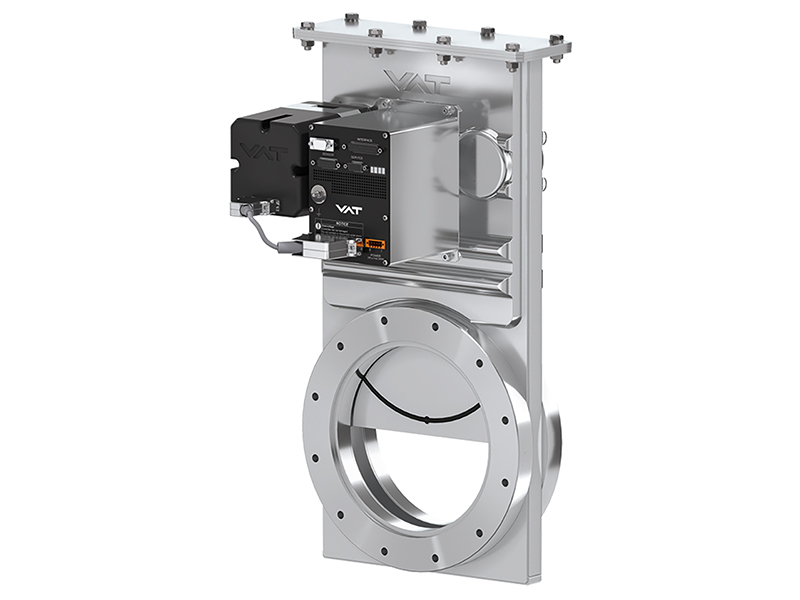
VAT vacuum valve. Isolates chambers, controls gas flow, vents / pumps chambers.
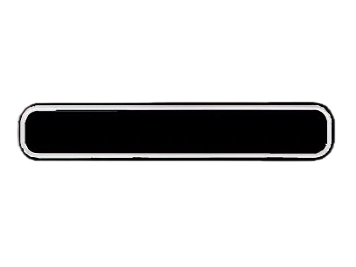
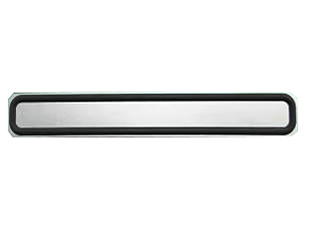
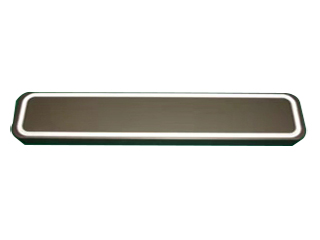
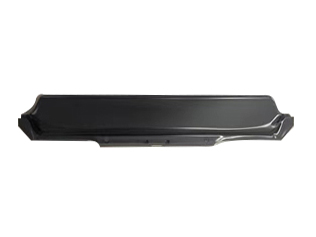
Slit valve door. Allows wafer transfer between chambers without breaking vacuum.
FFKM (Kalrez) O-ring seal. Provides UHV-grade sealing at high cycle count.
Beyond these four, supporting components include wafer transfer robots, gas mass flow controllers, throttle valves, viewports, and showerheads.
What Is the Role of the ESC?
The ESC holds the wafer during plasma processing, providing thermal contact for wafer temperature control and a uniform clamping force to prevent wafer slip or bounce. The ESC is the most complex component in the process chamber because it integrates ceramic dielectric, embedded electrodes, backside gas distribution, and RF / DC feedthroughs.
|
ESC function |
Detail |
|
Wafer clamping |
Electrostatic attraction, 30–100 g/cm² |
|
Thermal control |
Backside gas + liquid cooling |
|
Plasma interface |
Ceramic, plasma-resistant |
|
RF coupling |
Bias to wafer (typ. 13.56 MHz, 2–27 MHz) |
|
Lifetime |
6–18 months in production etch |
See Article 01 for detailed ESC selection criteria. Hitron's Electrostatic Chuck family covers the standard ESC product range.
What Is the Role of the VAT Vacuum Valve?
The
VAT vacuum valve isolates chambers, controls gas flow, and vents / pumps process modules, providing the high-cycle, low-leak sealing required for production semiconductor tools. VAT valves are differentiated from slit valve doors by their circular sealing geometry and broader application scope.
|
VAT valve function |
Detail |
|
Chamber isolation |
Gate valve, FFKM or metal seal |
|
Foreline isolation |
Angle valve, FFKM or FKM |
|
Gas line isolation |
Poppet valve, high cycle |
|
Venting / pumping |
Angle valve or poppet |
|
Lifetime |
1,000,000+ cycles (FFKM) |
See Article 03 for detailed VAT valve selection criteria. Hitron's VAT Vacuum Valve family covers the standard product range.
What Is the Role of the Slit Valve Door?
The
slit valve door is the rectangular moving seal that allows wafer transfer between adjacent chambers in a cluster tool, providing 1–10 million cycle life with UHV sealing and minimal particle generation. Slit valve doors are uniquely semiconductor-tool components because their rectangular shape matches the wafer / robot footprint.
|
Slit valve door function |
Detail |
|
Wafer transfer |
Rectangular opening, robot pass-through |
|
Chamber isolation |
FFKM or metal seal |
|
High-cycle actuation |
Pneumatic or electric |
|
Particle control |
< 3 particles per actuation |
|
Lifetime |
1,000,000 to 10,000,000 cycles |
See Article 02 for detailed slit valve door selection criteria. Hitron's Slit Valve Door family covers the standard product range.
What Is the Role of the FFKM O-Ring?
The FFKM O-ring provides UHV-grade sealing at high cycle count and high temperature, with the broadest chemical compatibility among elastomers. FFKM is the standard sealing material for production semiconductor tools because of its MTBF advantage over FKM and EPDM.
|
FFKM O-ring function |
Detail |
|
Static seal |
O-ring, square ring, custom gasket |
|
Dynamic seal |
Lip seal, U-cup (limited) |
|
Plasma service |
Compound-dependent erosion |
|
Temperature range |
+200 to +325 °C (compound-dependent) |
|
Lifetime |
6–18 months in production etch |
See Article 04 for detailed FFKM selection criteria. Hitron's Kalrez O-Ring family covers the standard FFKM compounds.
How Do These Components Work Together?
In a typical 300 mm etch cluster tool, the four components interact as follows: the slit valve doors open to allow wafer transfer between chambers; the VAT valves isolate the chambers from the foreline and gas lines; the ESC holds the wafer during plasma processing; and the FFKM seals provide UHV-grade sealing throughout. The interaction determines the tool's uptime, throughput, and yield.
Example: 300 mm dielectric etch cluster tool
|
Step |
Component |
Action |
|
1. Wafer entry |
Load lock slit valve door |
Open to allow wafer entry |
|
2. Vacuum pump |
VAT foreline valve |
Pump load lock to < 10⁻⁶ Torr |
|
3. Load lock to transfer |
Slit valve door |
Open to transfer chamber |
|
4. Transfer to etch |
Slit valve door |
Open to etch chamber |
|
5. Wafer clamping |
ESC |
Clamp wafer (J-R, ±1000 V) |
|
6. Process |
ESC + plasma |
Etch wafer |
|
7. De-clamp |
ESC |
Release wafer |
|
8. Transfer to next chamber |
Slit valve door |
Open |
|
9. Wafer exit |
Load lock slit valve door |
Open for exit |
Throughout the cycle, FFKM seals (in slit valves, VAT valves, chamber flanges) maintain vacuum integrity, and the ESC maintains wafer temperature via backside He.
What Is the Typical Chamber Architecture?
A typical 300 mm plasma etch chamber includes an ESC pedestal at the bottom, a showerhead at the top, a slit valve door on the side, a viewport for optical monitoring, and various gas and foreline ports sealed by FFKM O-rings and VAT valves. The chamber wall is typically aluminum or ceramic with a clamp / bolt flange.
|
Component |
Location |
Function |
|
ESC pedestal |
Bottom |
Wafer clamping, cooling |
|
Showerhead |
Top |
Gas distribution, plasma source |
|
Slit valve door |
Side |
Wafer transfer |
|
Viewport |
Side |
Optical emission, interferometry |
|
VAT foreline valve |
Bottom |
Pump isolation |
|
VAT gas valves |
Top |
Gas injection |
|
FFKM seals |
Throughout |
Static sealing |
|
Chuck lift pins |
Bottom |
Wafer lift / landing |
For advanced-node etch (sub-3 nm), the chamber is typically ceramic (Al₂O₃ or Y₂O₃) for plasma resistance, with the ESC pedestal and showerhead matched to the ceramic chamber design.
What Are the Standard Component Interfaces?
The four foundational components interface to the chamber and to each other through standard mechanical flanges (CF, ISO-K, ISO-F), electrical feedthroughs (RF, DC, HV), gas / vacuum ports (KF, VCR), and optical windows. Each interface must be sealed to UHV grade and isolated electrically where required.
|
Interface type |
Standard |
Application |
|
CF flange |
ISO 3669 |
UHV chamber port |
|
ISO-K flange |
ISO 1609 |
HV chamber port |
|
ISO-F flange |
ISO 1609 |
HV bolted |
|
KF flange |
ISO 2861 |
Foreline, small port |
|
VCR fitting |
Swagelok |
UHV gas line |
|
RF feedthrough |
50 Ω, N-type |
RF bias |
|
HV feedthrough |
5–30 kV |
ESC clamping |
|
Viewport |
CF, fused silica / sapphire |
Optical monitoring |
Hitron's Product page lists the standard component interfaces and the Application page describes process integration.
What Is the Lifecycle of These Components?
The lifecycle of the four foundational components in production is determined by preventive replacement intervals rather than failure-driven replacement, with the typical replacement intervals being ESC 6–18 months, VAT valve 12–24 months (FFKM) or 6–12 months (FKM), slit valve door 12–24 months, and FFKM O-rings 6–18 months. Preventive replacement minimizes unscheduled downtime and wafer scrap.
|
Component |
Replacement interval (production) |
Driver |
|
ESC |
6–18 months |
Particle, clamping drift |
|
VAT valve (FFKM) |
12–24 months |
Cycle, leak rate |
|
VAT valve (FKM) |
6–12 months |
Cycle, leak rate |
|
Slit valve door (FFKM) |
12–24 months |
Cycle, particle |
|
FFKM O-ring |
6–18 months |
Compression set, particle |
For high-uptime production fabs, components are replaced at 50–80 % of rated cycle life or end-of-life, whichever is shorter.
What Are the Failure Modes and Diagnostic Indicators?
The four foundational components fail in distinct ways that can be detected by chamber monitoring: ESC by clamping voltage drift and particle rise, VAT valve by leak rate rise and actuation force rise, slit valve door by leak rate and particle rise, and FFKM O-ring by compression set and particle rise. Each failure has a leading diagnostic indicator.
|
Component |
Leading indicator |
Failure mode |
|
ESC |
Clamping voltage drift, particle |
Dielectric wear |
|
VAT valve |
Leak rate, actuation force |
Seal wear, bellows fatigue |
|
Slit valve door |
Leak rate, particle |
Seal wear, edge damage |
|
FFKM O-ring |
Compression set, particle |
Seal aging, plasma erosion |
Predictive maintenance programs monitor these indicators and replace components before catastrophic loss of vacuum or wafer scrap. Hitron's About Us page describes the company's component-quality and traceability programs.
What About Wafer Transfer Robots and Other Components?
Beyond the four foundational components, wafer transfer robots (WTR), gas mass flow controllers (MFC), throttle valves, viewports, and showerheads complete the chamber architecture. These supporting components are also supplied by Hitron and other qualified vendors.
|
Component |
Function |
Detail |
|
Wafer transfer robot |
Wafer handling |
See Article 06 |
|
Gas mass flow controller |
Gas flow control |
See Article 10 |
|
Throttle valve |
Pressure control |
VAT-style, fast response |
|
Viewport |
Optical monitoring |
Fused silica / sapphire |
|
Showerhead |
Gas distribution |
Aluminum or ceramic |
Hitron's Product page lists the full front-end equipment component range, including ESC, VAT valves, slit valve doors, FFKM seals, and adjacent components.
Frequently Asked Questions
Q: What are the four foundational components of semiconductor front-end equipment?
A: Electrostatic chuck (ESC), VAT vacuum valve, slit valve door, and FFKM (Kalrez) O-ring seal. Together they enable wafer handling, wafer clamping, chamber isolation, and high-cycle sealing in every plasma-based process tool.
Q: What is the typical production lifetime of an ESC?
A: 6–18 months in production 300 mm etch, replaced at preventive maintenance based on clamping voltage drift and particle count rise.
Q: What is the typical production lifetime of a slit valve door?
A: 12–24 months in production, replaced at 1–10 million cycles depending on the seal material (FFKM vs. metal).
Q: What is the typical production lifetime of a VAT vacuum valve?
A: 12–24 months for FFKM-sealed; 6–12 months for FKM-sealed. Bellows life is typically the limiting factor.
Q: What is the typical production lifetime of a FFKM O-ring?
A: 6–18 months depending on plasma chemistry, temperature, and uptime. Particle generation is the leading indicator.
Q: Are these components OEM-specific or interchangeable?
A: Many components are interchangeable between OEMs (FFKM seals, some VAT valves, some slit valves). ESCs are typically chamber-specific. Hitron provides OEM-compatible and aftermarket replacements.
Q: Does Hitron provide all four foundational components?
A: Yes. Hitron's Electrostatic Chuck, VAT Vacuum Valve, Slit Valve Door, and Kalrez O-Ring families cover the four foundational components.
Q: How does Hitron ensure component quality?
A: Hitron's quality program includes material traceability, dimensional inspection, leak-rate testing, and particle testing per SEMI standards. See About Us for the quality program.
Q: What other components does Hitron supply?
A: Hitron's Product page lists ESC, VAT valves, slit valve doors, FFKM seals, and adjacent front-end equipment components.
Conclusion
The four foundational components of semiconductor front-end equipment — ESC, VAT vacuum valve, slit valve door, and FFKM O-ring seal — work together to enable wafer handling, wafer clamping, chamber isolation, and high-cycle sealing in every plasma-based process tool. Understanding the interaction, the interfaces, and the lifecycle is essential for tool uptime and wafer yield. Hitron's Electrostatic Chuck, VAT Vacuum Valve, Slit Valve Door, and Kalrez O-Ring product lines cover the four foundational component families, with the Product page listing the complete front-end equipment component range and the Application page describing process integration. For product range, certifications, and engineering support, consult the About Us and Contact Us pages.