Alloy And Seal Architecture Inside A VAT Stainless Steel Gate Valve
Release time:2026-12-07
Visits:15
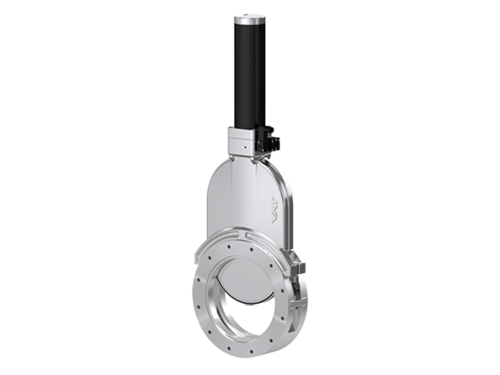
Two gate valves can share an outline drawing and still behave differently after a year in service, because the difference sits in the alloy and the seal stack rather than in the flange pattern. A VAT Stainless Steel Gate Valve (VAT is a trademark of VAT Group AG) is a body, a plate, a bellows and a seal line, and each of those four parts fails for its own reason. Hitron supplies compatible replacements and writes the comparison below from the bench.
304 and 316L: The Difference That Shows Up in Service
Molybdenum is what you are paying for
Both alloys are austenitic stainless steel, and both are non-magnetic. That is why they interchange on most drawings. The practical difference is the molybdenum addition in 316L, and what it buys is resistance to pitting and crevice attack in the presence of chlorides. A valve that sees halogen-containing process gas, chloride-bearing residue or a wet clean cycle will show that difference at the weld heat-affected zone first, where the passive layer is weakest.
Look at where the valve actually sits before deciding. A body that only ever sees nitrogen, argon or dry air will not develop pitting no matter how long it runs, while a valve on a chamber that sees halogen chemistry will attack at the weld long before the plate seal gives trouble. Alloy life and seal life are separate clocks, and they rarely run at the same rate. The body of a VAT Stainless Steel Gate Valve is usually called out by grade on the drawing, and the drawing rarely explains why that grade was chosen.
When 304 is the correct call
316L is not automatically better, and specifying it out of habit costs money on parts that never needed it. A nitrogen-purged load lock, a dry foreline, a clean research port running noble gas: 304 handles all of these for the life of the tool, welds more predictably, and leaves budget for the seal stack where it matters more. The alloy decision should follow the chemistry the wetted surface actually meets, not the specification of the tool's most demanding chamber. Hitron supplies both grades on the same body drawing, so the argument can be settled on chemistry rather than on habit.
Surface finish and weld prep decide more than the grade
A 316L body with a rough internal weld bead will outgas more than a well-prepared 304 body. Internal surface finish, weld purge quality and passivation matter as much as the alloy on the certificate. Ask for the internal finish to be stated, and inspect a bellows weld under magnification before accepting a delivery. That single inspection catches more problems than any paperwork.
|
Criterion |
304 |
316L |
What decides it |
|
Chloride or halide exposure |
Not suitable |
Preferred |
Process chemistry on the wetted face |
|
Clean dry service |
Adequate |
Over-specified |
Cost versus margin |
|
Weldability in thin sections |
Predictable |
Similar, procedure decides |
Purge control on the day |
|
Bake at 250 °C |
Acceptable |
Acceptable |
Seal stack, not alloy |
|
Cost position |
Lower |
Higher |
Where the margin is genuinely needed |
Seal Architecture: Bellows, Vulcanized Seals and Elastomer Choice
The welded bellows is the primary barrier
The stem has to move, and every place it moves is a potential leak path. A welded metal bellows feedthrough removes that path by enclosing the stem in a flexible metal envelope welded at both ends, so the actuator stroke is taken up by convolution flexing rather than by a sliding elastomer. Nothing wears against a shaft. Nothing sheds particles into the vacuum side. On a
VAT Stainless Steel Gate Valve the bellows is also the part that decides whether the stem line can still be trusted after a bake cycle. Bellows life depends on stroke length, cycle count and whether the valve is stroked against a pressure differential it was not designed for.
Inspect the bellows as a wear part rather than as a permanent feature. Convolution cracking starts at the weld toe, and it shows up as a helium signal at the feedthrough that grows with every stroke. A bellows that has run past its stroke rating fails in fatigue rather than by corrosion, so its replacement interval belongs in the maintenance plan next to the seal.
Vulcanized seals below DN 200
Below DN 200, a vulcanized seal is a better answer than a conventional O-ring in a groove. The elastomer is bonded directly to the plate, so there is no groove to trap gas, no O-ring to roll out of position during a closure, and no gap behind the seal for a virtual leak to hide in. Bonded seals also hold up better through bake cycles because the elastomer cannot creep along the groove. Above that size the bonding area and the differential load make both the economics and the process control harder. That is why the practice is bounded rather than universal. Hitron supplies bonded seals for the sizes where the practice holds.
Lubricant-free running changes the friction budget
A lubricant-free valve removes the hydrocarbon film that would otherwise migrate to the wafer side, and it survives a 250 °C bake without the grease breaking down into a deposit. The cost is friction at every moving interface. That is not a small trade, and it is the reason the closure mechanism deserves as much attention as the seal compound itself.
|
Architecture |
Main strength |
Main limitation |
Where it fits |
|
Welded metal bellows |
No sliding stem seal, clean vacuum side |
Stroke and cycle limits, weld quality critical |
All high vacuum positions |
|
Vulcanized bonded seal |
No groove volume, stable through bake |
Practical below DN 200 |
Plate sealing on smaller bores |
|
O-ring in a groove |
Replaceable in the field, low cost |
Groove volume, roll-out risk |
Larger sizes, service access |
|
Metal gasket flange joint |
Lowest permeation, bake capable |
Single use, surface damage sensitive |
UHV and CF-F connections |
Why the Locked Closure Spares the Seat
Sliding contact is what wears an elastomer
A conventional gate closes by pushing the plate across the seat while the two are already touching. The elastomer is sheared with every stroke. Damage accumulates as abrasion plus compression set. A gate can therefore test perfectly at installation and leak two thousand closures later with no change in the process. The seal did not degrade chemically. It was wiped to death mechanically.
The lock removes the shear
VAT lock technology is a mechanical arrangement that brings the plate into position first and locks it there, so the sealing force is applied after travel is complete. The seal compresses without being dragged, and the seat line stays where it was machined. Read that as a wear mechanism being removed rather than a feature being added. On a position that cycles a thousand times a week, the difference between sliding and locked closure decides the maintenance interval.
Reading a cycle rating correctly
The VAT 10.8 series is rated for 50,000 maintenance-free cycles, while general high vacuum gate valves are designed around a service life running into the hundreds of thousands of cycles. Neither number survives bad installation. A valve bolted down with uneven torque, run without bake protection on its elastomer, or stroked against atmosphere on the wrong side will fail well inside its rating. Hitron supplies compatible replacements built to the same rating logic, so compare like with like and then protect the figure with installation discipline.
Flanges, Gaskets and Torque Sequence
ISO-F, CF-F, ASA-LP and JIS in practice
The flange standard tells you what the joint can do before you read any other line on the drawing. ISO-F uses a clamped elastomer gasket. It comes apart quickly, which suits production positions. CF-F uses a knife-edge metal gasket and is the choice when bake and 10⁻¹⁰ mbar are both required, at the cost of a single-use gasket each time. ASA-LP follows the imperial 150 lb pattern common on US-built tools, and JIS appears on Japanese platforms. A replacement valve must match the mating flange on the tool, not the one on the removed part, because adapters add a joint and every joint is a leak path.
|
Standard |
Sealing element |
Bake capable |
Typical position |
|
ISO-F |
Clamped elastomer gasket |
Limited |
Load lock, rough and fine vacuum |
|
CF-F |
Knife-edge metal gasket |
Yes |
UHV, research, bake-heavy tools |
|
ASA-LP |
Elastomer gasket, imperial pattern |
Limited |
US-built process modules |
|
JIS |
Elastomer gasket, metric pattern |
Limited |
Japanese platforms |
Torque order matters more than torque value
Bolts on a VAT Stainless Steel Gate Valve flange are not a clamping force problem, they are a distribution problem. Tightening in a circle pulls the flange down on one side and lifts it on the other, and the gasket takes a permanent uneven set. Work in a cross pattern, in two or three increasing stages, and finish at the specified value rather than starting there. After a bake cycle, re-torque cold, because the joint relaxes as it returns to room temperature and a leak that appears a day after bake usually traces back to this step.
Leak Testing: What Each Method Actually Proves
Helium spray finds the real leak
Helium sprayed at a suspect joint locates an actual through-path. The valve has to be under vacuum on the inside for the signal to appear. The method is fast and directional, and it names the joint at fault when several sit close together. Spray the seat line, the bellows weld, the flange joint and the body weld in sequence rather than all at once, or the signal will not point anywhere.
Rate-of-rise finds the virtual one
A rate-of-rise test with the valve isolated measures everything inside the volume, including trapped gas and surface hydrocarbon, so it answers a different question. A
VAT Stainless Steel Gate Valve that passes helium and fails rate-of-rise has a virtual leak or a contaminated internal surface, not a hole. Running both tests is the only way to separate the two, and the order matters: helium first, rate-of-rise second.
Run the rise test long enough to separate a real leak from the slow drift of the gauge itself. A short test on a large volume will hide a small leak, and a long test on a contaminated surface will report a leak that does not exist. Log the rise curve instead of a single endpoint value, and the shape of the curve will tell you which of the two you are looking at.
Repeat the test cold after bake
A leak check performed at temperature tells you the seal is working while it is hot. The result that matters is the one taken after the valve has cooled, because compression set and differential contraction both act on the way down. Wuxi Hitron Semiconductor Co., Ltd. supplies these valves, bellows assemblies and bonded seals as compatible replacements, and a drawing number with the flange standard and bake requirement is enough to quote the correct build. Reach the team on +86 18101522032 or at Jerry@hitronsemi.com.