Electroadhesion Suction Cup: Where Vacuum Alone Loses The Wafer
Release time:2026-11-27
Visits:10
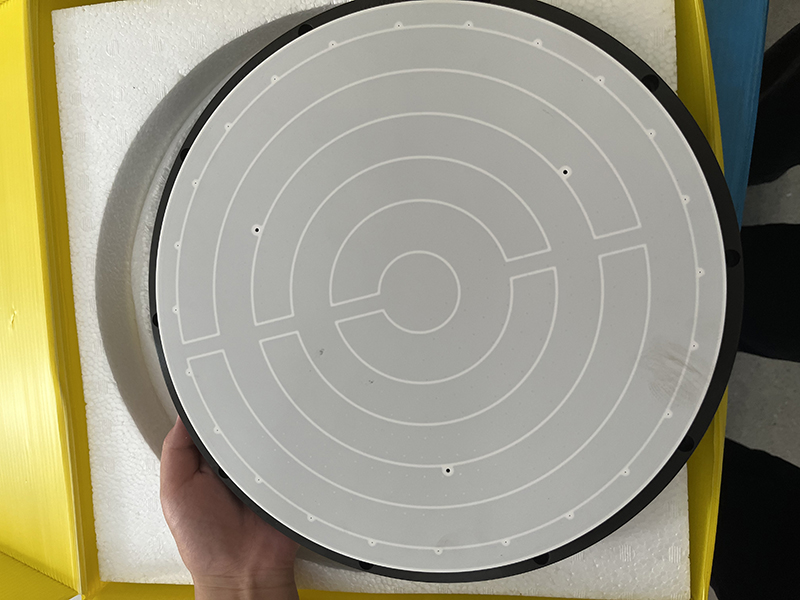
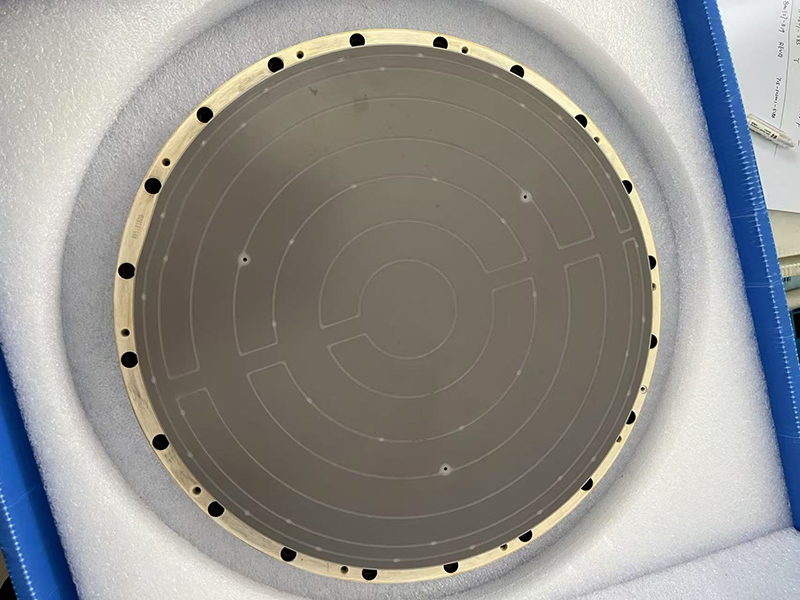
At 03:40 the transfer robot reports no wafer on the end effector. The wafer is on the load lock floor. The vacuum log shows a clean pull-down, the solenoid fired, the pressure switch confirmed. Nothing in the data explains the drop, yet the part is gone. An electroadhesion suction cup changes that picture because it does not depend on a single holding force, and Hitron supplies replacement units for the LAM and TEL platforms where these events land.
The Drop That Starts Every Investigation
Grip loss gets blamed on the cup. In most teardowns the cup is fine. What failed is the assumption that the workpiece presents a continuous, non-porous surface to the lip. Production drifts in ways nobody schedules. A new lot of ceramic substrates arrives with a coarser grind. A film stack gets thinner. A carrier ring warps after cleaning. The gripper was qualified on a different surface than the one it now sees.
Operators describe the same three symptoms regardless of platform. The part shifts during the move but stays attached. The vacuum switch stays satisfied while the part slides. The part releases early on the exhaust stroke and lands short of the target pocket. Each symptom points at a different part of the grip.
Three Failure Signatures on the Same Gripper
Rough surfaces break the seal into islands. The pump keeps pulling, the gauge reads acceptable because the leak is distributed rather than catastrophic, and the area actually holding the part is a fraction of the lip footprint. Porous parts behave worse, since air moves through the body of the workpiece and no amount of pumping reaches a stable differential. Thin films and warped edges add a lever arm that peels the lip from one side.
|
Signature |
What the operator sees |
Physical cause |
Response |
|
Rough ground face |
Gauge reads normal, part creeps |
Seal contact split into islands |
Pad that conforms to texture |
|
Porous body |
Pump runs continuously, grip stays weak |
Air path through the workpiece |
Force that ignores porosity |
|
Thin film or tape |
Part peels from one edge |
Low bending stiffness, peel moment |
Distributed force over the full pad |
|
Warped carrier ring |
Release on the exhaust stroke |
Uneven lip contact, gap at the high side |
Conforming pad plus field clamp |
Why Effective Sealing Area Collapses on Rough and Porous Parts
A vacuum cup holds because atmospheric pressure acts on the enclosed area. Halve the sealed perimeter and the force does not halve. The differential disappears along that arc, and the remaining arc carries a peeling moment. That is how a small loss of contact produces a total release. Thickness matters as much as texture, because a thin film cannot resist a peel load that a thick substrate shrugs off.
Porous ceramic and green-tape parts are the worst case. Air passes through the body, so the pump fights an open leak path it can never close. More pump capacity buys time, not grip. Something has to act on the surface itself.
How the Dual Mechanism Fills the Gap
A hybrid cup adds a second force that does not care about porosity. The vacuum side still does the heavy lifting on smooth parts. The electrostatic side closes the micro gaps and carries the load when the differential cannot form.
Porosity is the variable that separates the two channels most clearly. A dense silicon wafer and a sintered ceramic plate can share the same footprint and the same mass, yet only one of them holds a stable differential across the lip.
Vacuum Pressure Differential Remains the Load Bearing Component
Keep the pump channel exactly as it is. Removing air from the cup produces the pressure differential that presses the lip against the workpiece, and on a smooth, non-porous surface this is still the most efficient way to move mass. A hybrid electroadhesion suction cup does not replace that. It keeps the fast pull-down that keeps cycle time short, then adds a force that survives the surfaces vacuum cannot handle.
Electroadhesion Adds a Field Driven Clamp
Inside the soft pad at the base of the cup sit stretchable electrodes. High voltage on those electrodes generates an electrostatic field. The workpiece surface answers with opposite-polarity charge, and the two attract. The pad conforms, so the field bridges micro gaps that a rubber lip cannot close. Rough surfaces and porous bodies stop being disqualifying. An electroadhesion suction cup therefore grips glass, plastic, thin films, fabrics, and semiconductor wafers, which is the line that matters when one line runs several substrate types.
Holding Force, Surface Protection, and Cycle Time Together
Force arrives spread across the pad rather than concentrated at a few contact points, so there is no scribe line and no witness mark on a polished face. Shape freedom comes from the same construction. Rectangular pads, round pads, and stretchable pads cover flat plates, rings, long sections, and awkward geometry without a dedicated fixture per part. Control is a button or a switch, and clamp and release are fast enough to shorten the move.
Monitoring, Energy, and Dwell Behavior
Two physical channels mean two things to watch. A gripper that reports only vacuum is blind to half of its own condition.
Closed Loop Channels on Both Sides of the Cup
Continuous monitoring of vacuum level and electrostatic parameters catches drift before it becomes a dropped wafer. A rising leak rate on the vacuum channel with a stable field usually means lip wear or contamination. A field that needs more voltage to reach the same holding state points at pad degradation or a cable path problem. Because an
electroadhesion suction cup reports both channels, maintenance can change a pad on schedule instead of after a scrap event.
Power Draw During Long Dwell
Holding a charged pad costs very little current once the field settles, which is what makes the technology usable on a tool that parks a workpiece for minutes at a time. The energy argument is not about the peak. It is about the average across a full shift of continuous operation.
What matters in a cost review is the supply, not the hold. A high-voltage module sized for the pad and the cable length runs cool at steady state; an undersized one saturates and heats, and heat sitting next to a precision pad shortens its life. Size for the release transient rather than the dwell.
Three-Way Comparison: Electroadhesion, Magnetic, Mechanical
Three ways to move a part, three different failure envelopes. Choosing between them is a question of what the workpiece is made of and how much of its surface you are allowed to touch.
Magnetic Fixtures and the Ferromagnetic Limit
Magnetic holding is strong and simple, and it stops working the moment the part is not ferromagnetic. Aluminum, ceramic, glass, polymer, and every semiconductor wafer fall outside its range. Where steel carriers are in play, magnetics remain a reasonable choice. On a mixed line they force a second gripper and a second qualification cycle. A dual-mechanism cup covers the whole mixed line with one end effector.
Mechanical Clamping and Edge Damage
Mechanical jaws are material-agnostic and easy to reason about. They also apply point loads at the edge, and edge damage on a thin substrate becomes a particle source upstream of the process chamber. Clamp force has to be high enough to survive acceleration and low enough not to chip, and that window narrows as parts get thinner.
Shops that have lived through a chipped carrier ring tend to overcorrect and drop clamp force, which trades edge damage for slip during acceleration. Neither setting stays valid across a product mix.
|
Attribute |
Dual-mechanism cup |
Magnetic fixture |
Mechanical clamp |
|
Workpiece material |
Non-metallic and metallic, porous or smooth |
Ferromagnetic only |
Any solid |
|
Force distribution |
Spread across the pad |
Concentrated at poles |
Point loads at jaws |
|
Edge risk |
Low, no contact mark |
Low |
Chipping and micro-cracks |
|
Cycle time |
Fast clamp and release |
Fast |
Slower, jaw travel |
|
Main consumable |
Pad and electrode assembly |
Pole face wear |
Jaw inserts and pads |
The trade-off is not subtle. Magnetics win on steel and lose everywhere else. Jaws win on robustness and lose on edge quality. A dual-mechanism cup wins on material range and pays for it with a high-voltage supply and a pad that wears.
Specifying a Replacement Gripper
Hitron quotes against the platform, not the part number alone. The same physical cup shape appears under several LAM and TEL numbers with different pad materials and connector arrangements, and a unit that fits mechanically can still be wrong electrically.
Model Coverage on LAM and TEL Platforms
Hitron catalogs electroadhesion grippers, suction cups, and hybrid pads against the platforms they run on. The table below lists the part numbers that come up for these platforms.
|
Part number |
Site description |
Platform |
|
839-019090-225 C |
Electroadhesion Grippers |
LAM |
|
839-019090-328 D |
Electroadhesion Suction Cup |
LAM |
|
839-019090-374 |
Electroadhesion Suction Cup |
LAM |
|
839-019090-620/H |
Electronically Controlled Suction Cup |
LAM |
|
C3BE-05009 |
Magnetically Switchable Soft Suction Gripper |
TEL / LAM |
|
83331NP-15916 |
Stretchable Suction Cup |
TEL |
|
715-100675-135D |
Soft Hybrid Suction Cup, LAM 100675 series Grade D |
LAM |
|
82448NP-43312 |
Vacuum Suction Cup |
TEL |
Each unit is a compatible replacement built to the original envelope and connector interface. LAM and TEL brand names belong to their owners, and a matching part number indicates fitment rather than OEM authorization.
What to Send Before a Quote
Send the tool model, the part number stamped on the current unit, a photo of the pad face, and the workpiece description with material and surface finish. Add the failure history if there is one. How many wafers ran before the drop, whether the drop followed a lot change, whether the vacuum gauge ever moved on the trend screen. Hitron uses those four data points to decide whether a standard
electroadhesion suction cup is enough or the pad needs a different durometer.
Wuxi Hitron Semiconductor Co., Ltd. builds these units in Wuxi, Jiangsu, on a 3,000 ㎡ floor with a localized spare parts inventory, so a replacement does not wait on an international shipment. Send the tool model and part number to the team at +86 18101522032 or Jerry@hitronsemi.com.