Rubber Sealing Rings Explained: A Comprehensive Guide To Types, Materials, Applications, And Why Quality Manufacturing Matters
Release time:2026-08-14
Visits:253
In the vast landscape of industrial components, the rubber sealing ring stands as one of the most underappreciated yet absolutely critical inventions. From the depths of subsea oil extraction equipment to the sterile environment of a pharmaceutical filling line, these deceptively simple circular components perform a task that underpins modern civilization: they keep fluids and gases exactly where they belong. Without a properly functioning rubber sealing ring, hydraulic systems fail, engines seize, chemical processes leak, and entire production lines grind to a halt.
What Exactly is a Rubber Sealing Ring?
At its most fundamental level, a
rubber sealing ring is an elastomeric component, typically toroidal (doughnut-shaped) or with a specialized cross-sectional profile, designed to occupy a precisely machined groove between two mating surfaces. When compression is applied during assembly, the rubber deforms elastically, flowing into the microscopic imperfections of the metal surfaces and creating an intimate, impermeable barrier. What makes this so ingenious is the material's ability to store energy like a spring—as the sealed system experiences pressure pulses, thermal expansion, or vibration, the rubber continuously adapts, maintaining contact stress that exceeds the internal pressure of the fluid or gas being contained.
This dynamic sealing behavior is known as "self-energization." As system pressure rises, the rubber element is forced more tightly against the downstream wall of its groove, actually increasing the sealing force proportional to the pressure load. This means a single, properly specified sealing ring can handle a remarkable range of operating conditions, from deep vacuum to hundreds of bar, without any adjustment or maintenance.
The Critical Role of Material Selection
The term "rubber" encompasses a vast family of elastomeric polymers, each with distinct chemical structures that yield dramatically different performance characteristics. Selecting the wrong material for a sealing application is one of the most common and costly engineering mistakes. Let us examine the major rubber families in detail:
Nitrile Butadiene Rubber (NBR): This is by far the most widely used sealing elastomer globally, and for good reason. NBR offers an outstanding balance of oil and fuel resistance, mechanical strength, and cost-effectiveness. The acrylonitrile content (ACN) in NBR can be varied from approximately 18% to 50%, creating a tunable balance between oil resistance (higher ACN) and low-temperature flexibility (lower ACN). A standard 34% ACN compound provides a service temperature range of approximately -30°C to +100°C, making it the go-to material for automotive fuel systems, hydraulic cylinders, and industrial gearboxes. However, NBR has a fundamental weakness: its unsaturated polymer backbone makes it highly susceptible to ozone attack. Exposure to atmospheric ozone causes characteristic surface cracking perpendicular to the direction of strain. This can be mitigated through the use of antiozonant additives or, better yet, by selecting a saturated-backbone polymer for outdoor applications.
Ethylene Propylene Diene Monomer (EPDM): EPDM possesses a completely saturated polymer backbone, rendering it immune to ozone and UV degradation. This makes it the premier choice for outdoor applications, such as building seals, solar equipment, and automotive weatherstripping. EPDM also exhibits exceptional resistance to water, steam, and polar solvents like brake fluids and glycol-based coolants. Its temperature range extends from approximately -50°C to +150°C, with specialized peroxide-cured grades reaching even higher. The critical limitation of EPDM is its complete incompatibility with mineral oils and hydrocarbon fuels. When exposed to these substances, EPDM swells massively and rapidly loses all mechanical integrity. This means an EPDM seal must never be installed in an engine oil or diesel fuel application—the result would be catastrophic swelling and failure within hours.
Silicone Rubber (VMQ): Silicone offers the broadest continuous operating temperature range of any commercially available elastomer, maintaining elasticity from approximately -60°C to +225°C. Its physiological inertness makes it a favorite in medical devices, food processing equipment, and pharmaceutical manufacturing. However, silicone has relatively poor tensile strength, tear resistance, and abrasion resistance compared to other elastomers. It is also highly permeable to gases, making it unsuitable for vacuum or gas-barrier applications without specialized formulations. In dynamic sealing applications involving sliding motion, silicone's relatively high coefficient of friction and poor wear characteristics can lead to rapid degradation.
Fluorocarbon Rubber (FKM, Viton®): Representing a significant step up in performance, FKM compounds contain 65-71% fluorine by weight, imparting exceptional resistance to aggressive chemicals, fuels, and high temperatures up to 200°C continuously. The higher the fluorine content, the greater the chemical resistance, but also the higher the cost and the poorer the low-temperature flexibility. We will explore FKM in much greater detail in a dedicated section of this series.
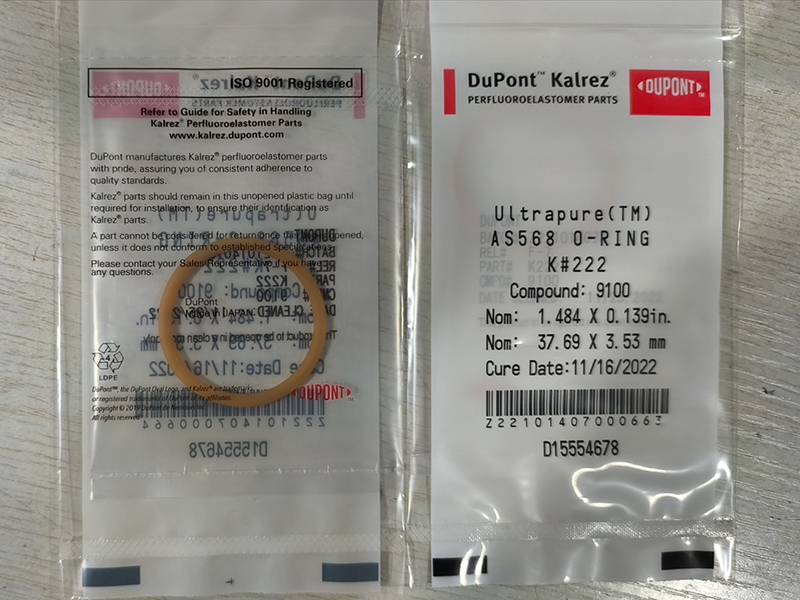
Perfluoroelastomer (FFKM): Sitting at the absolute pinnacle of elastomeric performance, FFKM is essentially the combination of PTFE's chemical inertness with true elastomeric elasticity. With a fluorine content approaching 75% and a fully fluorinated backbone, FFKM resists virtually all chemical agents across a temperature range that can span from cryogenic conditions to over 300°C. The cost is proportionally extreme, but for semiconductor plasma processes, aggressive upstream oil and gas applications, and critical aerospace systems, no alternative exists.
The Manufacturing Quality Imperative
A rubber sealing ring may appear simple, but its reliable performance depends on extraordinarily precise manufacturing. The dimensional tolerances for O-ring cross-sections, for example, are typically specified to ±0.08mm or tighter according to ISO 3601 or AS568 standards. A deviation beyond this range means either insufficient compression and leakage, or excessive fill and extrusion damage. The mixing and curing process must achieve complete dispersion of fillers, curatives, and protective additives—agglomerations of carbon black or unmixed curatives create microscopic flaws that can nucleate crack formation under cyclic loading. Post-curing, an often-skipped step by low-cost manufacturers, is essential for driving off volatile byproducts and completing the crosslinking reaction, which stabilizes the material's compression set resistance.