Parallel Seal Slit Valve: The Motion Sets Particle Performance, Not The Material
Release time:2026-12-18
Visits:17
Two slit valves can be built from the same stainless steel, the same door insert and the same actuator, and still behave completely differently on a particle monitor. The difference is usually the sealing motion — how the door travels before it touches the sealing land.
A parallel seal slit valve separates those two functions: the door travels in a straight line across the aperture, then closes onto a flat land with a controlled compression stroke. A wedge or flap design couples them, so every stroke drags the seal across the land at an angle.
Wuxi Hitron Semiconductor Co., Ltd. manufactures slit valve doors and valve components for thin-film and etch platforms, alongside FFKM seals, electrostatic chuck hardware and vacuum valve replacements. What follows is the mechanical argument we use when a fab asks why a transfer chamber keeps showing particle events after a door replacement.
Where the Valve Sits in the Tool Line
The slit valve is the aperture between a transfer chamber and a process chamber, or between a load lock and the transfer chamber. It is open during wafer exchange and closed during processing, when the process chamber may be at vacuum, at pressure, or cycling between the two.
That position makes it a strange component. It is not a process-critical part in the way a showerhead is, but it is on the path of every wafer, and its failure modes are unusually visible:
- a slow leak that shows up as pump-down time drift
- particles that appear only after a door cycles
- a door that no longer seats fully after a few thousand cycles
- an actuator that reports closed while the seal is still marginal
None of these announce themselves loudly. All of them cost yield.
Two Ways to Close an Aperture
|
Feature |
Parallel seal (linear-then-compress) |
Wedge / flap seal (combined motion) |
|
Door path before contact |
Straight line across the aperture, then normal to the land |
Angular sweep; seal contacts while still moving laterally |
|
Seal abrasion per cycle |
Very low; contact is nearly pure compression |
Higher; the seal slides against the land under load |
|
Particle generation |
Mostly from door travel and purge, not from seal scrub |
Seal scrub plus edge wear |
|
Required actuator |
Two-stage or guided with a compression stroke |
Single rotary or linear with linkage |
|
Seal wear pattern |
Uniform compression set across the face |
Asymmetric; leading edge wears first |
|
Best fit |
High-cycle transfer, particle-sensitive processes |
Low-cost, low-cycle, less critical apertures |
|
Maintenance signature |
Insert replacement at end of compression life |
Insert plus linkage adjustment and land rework |
The table is the whole argument in one place. A
parallel seal slit valve is not automatically better — it is better wherever cycling is high or particles are expensive, and it costs more actuator complexity to get there.
One Cycle, Step by Step
Understanding the sequence makes the wear pattern predictable.
1. Unlock. The door is held against the land by differential pressure or by a mechanical lock, depending on the design. Pressure equalization happens first; a door that opens against a pressure differential will tear its insert.
2. Retract. A short stroke, typically a few millimetres, moves the door normal to the land and breaks contact without lateral sliding.
3. Translate. The door moves across the aperture on a guide. This is the only phase with real lateral travel, and it happens with the seal already clear of the land.
4. Contact. The door returns normal to the land and touches the insert flat.
5. Compress. A defined stroke compresses the insert by the design squeeze — typically 15–25 % of cross section for an elastomer insert, or a much smaller value for a metal or polymer-faced design.
6. Hold. Process pressure and the mechanical lock maintain the seal. This is where compression set accumulates.
Every wear mechanism in a parallel seal slit valve lives in step 5 and step 6. If the compression stroke is too large, the insert takes a set and stops rebounding. If it is too small, the valve leaks at the cold end of the temperature range.
Where the Particles Come From
Particle excursions after a door cycle are often blamed on the seal, and the seal is often innocent. Four sources, in rough order of frequency:
- Door travel over the aperture. The door face and the aperture edge act like a sliding contact. A worn guide or a misaligned door produces a smear of metal or coating debris.
- Insert erosion. Plasma and radical exposure attack the insert face. Once the surface breaks down, filler particles and fragments enter the transfer chamber.
- Purge and vent transients. A fast vent lifts particles that were sitting quietly on the floor of the transfer chamber.
- Actuator and guide lubrication. The wrong grease in a vacuum mechanism is a particle source that never stops.
A parallel seal design removes one of those sources completely — seal scrub — which is why it is usually the right choice when the particle budget is tight.
What Wears Out First
|
Component |
Typical symptom |
Reason it fails first |
|
Door insert / seal face |
Leak rate creeps up; visible groove or erosion on the face |
Direct plasma and radical exposure, plus compression set |
|
Guide and bearing |
Door hesitates; particles after cycling; uneven seal contact |
Vacuum-compatible lubrication dries out or is depleted |
|
Actuator seal (bellows or rod seal) |
Slow leak at the actuator, not at the aperture |
Cycling fatigue; bellows work-hardening |
|
Door body coating |
Localized erosion near the aperture edge; particle events |
Ion and radical flux concentrated at the exposed edge |
|
Mounting hardware |
Torque loss, insert height drift |
Thermal cycling and vibration |
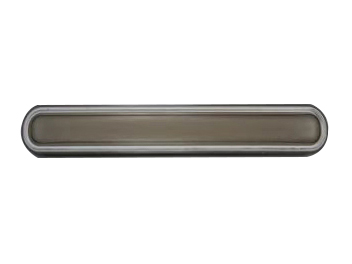
The door insert is the consumable. Everything else on the list is a maintenance interval decision.
Cycle Budget and Conductance
Two numbers define the commercial case for a parallel seal slit valve: cycles between insert replacements and conductance when open.
Cycle life depends on stroke accuracy far more than on the elastomer. A door that compresses the insert 20 % every cycle will outlast one that compresses it 30 % by a wide margin, even with an identical compound. If a tool is specified for 100,000 cycles and the insert is replaced every 20,000, the compression stroke is usually wrong — check the actuator stop before ordering a "better" seal.
Conductance matters during pump-down and wafer exchange. An aperture that is slightly undersized adds seconds to every pump-down, and those seconds multiply across the tool's wafer starts. When replacing a valve, match the aperture and the door opening height to the original design, not to what fits the bracket.
Specifying a Parallel Seal Slit Valve
Use this list and the quotation process becomes short.
|
Item |
What to state |
|
Aperture dimensions |
Width, height, corner radius, and the sealing land width |
|
Flange and interface |
Bolt pattern, face-to-face dimension, mounting orientation |
|
Pressure regime |
Base pressure, process pressure, differential across the door, vent rate |
|
Chemistry at the aperture |
Process gas, plasma exposure at the door face, cleaning chemistry |
|
Cycle requirement |
Cycles per day, target cycles between insert replacements |
|
Leak specification |
Allowable leak rate and the test method (helium, rate-of-rise) |
|
Actuation |
Pneumatic or electric, available air pressure, position feedback requirement |
|
Interlock |
Tool safety logic, door-open and door-closed confirmation signals |
|
Environment |
Ambient temperature, bakeout temperature, cleanroom class |
|
Part reference |
OEM part number and platform, so the replacement matches the original geometry |
Why Fabs Source These Doors From Hitron
Wuxi Hitron Semiconductor Co., Ltd. supplies slit valve doors and valve assemblies against OEM part references — for example the 77006-R1 and 78510-R1 doors used on Novellus/Speed and STS thin-film platforms, the 3870-00661 (8575) and 3870-04001 (G67P) doors for Applied Materials Producer tools, and the 0190-02853 and 0020-10202 doors for the P5000 family.
Behind the part numbers, three things matter to a maintenance engineer:
- Geometry matched to the original. Insert height, land width and door flatness are controlled so a replacement does not need field rework.
- Insert and coating options. Elastomer, polymer-faced and coated variants for different chemistry and cycle budgets.
- Response time. A 3,000 m² workshop and a stocked spare-parts inventory exist because a slit valve door is a downtime part, not a project part.
If a parallel seal slit valve is generating particles after a replacement, send us the door drawing, the cycle count and a photograph of the insert face. In most cases the answer is a stroke adjustment, not a new valve.
Contact: Jerry@hitronsemi.com · +86 18101522032 · Wuxi, Jiangsu, China