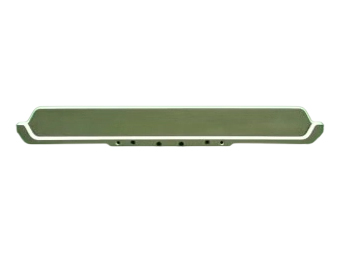
What Is An Electrostatic Chuck? A Complete Analysis Of Its Working Principles And Core Application Fields
Release time:2026-05-29
Visits:191
In the microscopic world of industrial automation and precision manufacturing, there is a special device that can grab objects without contact - the electrostatic chuck. It does not rely on the pressure of mechanical jaws or the stickiness of glue, but uses the force of an electrostatic field to firmly hold objects, becoming an invisible helper in high-end fields such as semiconductors and optics. Today, we will its essence, working principles, and why it occupies an irreplaceable position in precision manufacturing.
I. What is an Electrostatic Chuck?
Simply put, an electrostatic chuck is a device that uses electrostatic principles to achieve object fixation. Its core logic is: generate adsorption force through the electrostatic field of a dielectric or interface, making the object stick to the chuck surface - this non-contact fixation characteristic just solves the pain point in precision manufacturing of needing to fix without damaging.
Compared with traditional mechanical fixtures, the advantages of electrostatic chucks are obvious: they do not cause scratches or indentations on the object surface, nor do they cause deformation of tiny parts due to external forces. Therefore, they are particularly suitable for handling small, fragile, or high-precision workpieces.
II. Two Core Working Principles of Electrostatic Chucks
The adsorption capacity of electrostatic chucks comes from two different electrostatic effects. These two principles correspond to different application scenarios, but the core is converting electrostatic fields into adsorption force.
1. Coulomb Force Adsorption of Insulating Dielectrics
The core of the first principle is insulating materials as dielectrics. When an insulating material (such as ceramics or special plastics) is charged by an external power source, a uniform electrostatic field is formed on its surface. At this time, light and small objects (such as tiny metal sheets, plastic parts) will be adsorbed to the dielectric surface under the action of Coulomb force - similar to how a plastic ruler can pick up small pieces of paper after being rubbed against hair, but the electrostatic field of the electrostatic chuck is more stable and the adsorption force is more controllable.
This principle is suitable for adsorbing lightweight, dry-surfaced objects and is commonly used in the assembly of some small electronic components.
2. Dielectric Polarization in the Johnsen-Rahbek Effect
The second principle is more advanced and targets heavier or metal workpieces. When the workpiece contacts the dielectric surface, a tiny gap (almost invisible to the naked eye) between them allows a weak current to flow, triggering the dielectric polarization phenomenon - simply put, the current forms an enhanced electrostatic field at the interface between the workpiece and the dielectric, enabling even metal workpieces to be firmly adsorbed.
The advantage of this effect is stronger adsorption force and wider applicability, making it the most commonly used principle in semiconductor and optical manufacturing.
III. Core Application Fields of Electrostatic Chucks
The value of electrostatic chucks lies in solving pain point scenarios in precision manufacturing - those delicate workpieces that traditional tools cannot handle are exactly their main battlefield.
1. Semiconductor Packaging: Gentle Fixation of Chips
Semiconductor chips are as small as millimeters, and the circuits on their surfaces are so fragile that they break with a touch. In the chip packaging and testing process, chips need to be accurately fixed on the carrier board - this is where electrostatic chucks come into play: they gently hold the chips with an electrostatic field, neither crushing the circuits nor ensuring positional accuracy (errors can be controlled at the micrometer level), directly improving the yield rate of the packaging process.
2. Precision Optical Manufacturing: Non-Damaging Processing of Optical Components
Optical components such as lenses and prisms have extremely high requirements for surface accuracy - even a micrometer-level scratch can significantly reduce optical performance. In high-precision operations such as grinding and polishing, electrostatic chucks can fix these fragile components without contact, avoiding pressure damage from mechanical fixtures while maintaining stable component positioning, resulting in clearer and more precise processed optical products.
Conclusion: The Invisible Value of Electrostatic Chucks
The charm of electrostatic chucks lies in using invisible force to solve visible problems. From semiconductor chips to optical lenses, their applications are driving high-end manufacturing toward more precise and reliable directions - for industries that need to handle small, fragile, high-precision workpieces, electrostatic chucks are not an optional tool but a necessary tool.
In the future, as the demand for precision manufacturing increases, the application scenarios of electrostatic chucks will continue to expand - but what remains unchanged is that it will always be that gentle and reliable invisible gripper.